Background
Our Street Tree Strategy helps protect and increase our street tree canopy across Monash. This is something we know is very important to our residents because of the role it plays in cooling, shading and beautifying our streets.
We are inviting residents of Amblecote Crescent to let us know what type of tree you'd like to see us plant in your street.
Click 'Follow' at the top of this page to receive updates on the project, including the results of voting.
Why does Council identify trees for removal?
When assessing a street as part of our Street Tree Strategy, we flag trees for removal that are dead, dying (assessed as having less than five years useful life), diseased or dangerous (pose an inappropriate level of risk to people or assets that cannot be reasonably be managed).
These trees are then replaced where appropriate and we also look for other opportunities to plant trees on the street.
Amblecote Crescent, Mulgrave
Our arborists have completed individual tree assessments based on the above criteria. We will be:
- Removing 18 trees, and
- Planting 47 new trees.
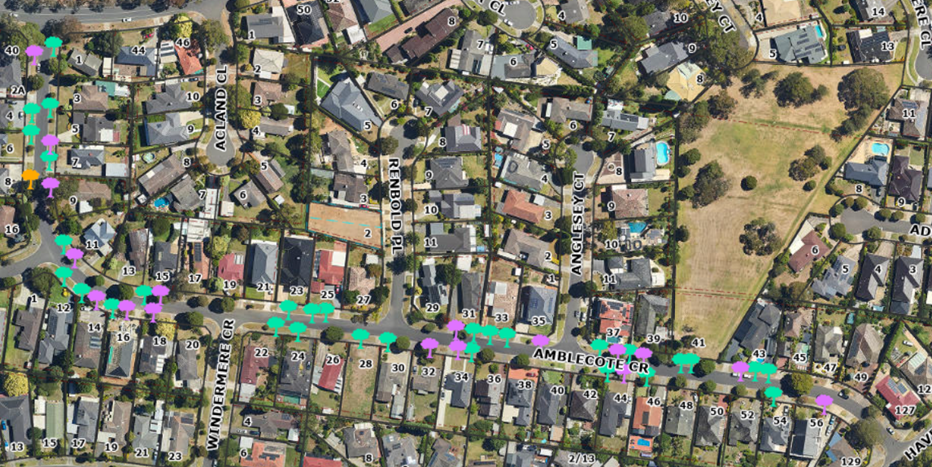
 Tree to be removed and replaced
 New tree
 Tree removed with no replacement
Species for replanting
Smooth-barked Apple (Angophora costata)

This attractive Australian native is loved for its smooth bark that is slightly purple in colour. It has large and twisted limbs and a very large, expanded trunk base. It bears white flower clusters in spring. This tree has opposite leaves compared to alternate leaves as seen in eucalypt tree varieties. It has beautiful red new growth.
Size - height x width: 20m x 12m
Foliage: Evergreen
Dwarf Yellow Bloodwood (Corymbia eximia ‘Nana’)

A smaller cultivated variety (cultivar) of Corymbia eximia (syn. Eucalyptus), the foliage is broad with a strong green colour and may turn a paler yellow/green in the colder months. The trunk adopts a striking sculptural appearance that has mottled, flaky brown bark. In Spring, the tree puts on an eye-catching display covering itself in creamy yellow flowers, attracting nectar loving birds.
Size - height x width: 6-8m x 4-6m
Foliage: Evergreen
Argyle Apple (Eucalyptus cinerea)
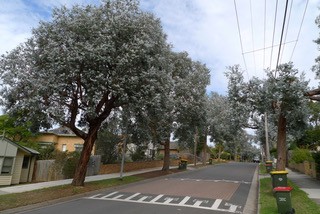
A small- to medium-sized tree that is endemic to south-eastern Australia. Spreading canopy sometimes with low branches (can be pruned up to provide clearances). Fibrous, red, stringy bark. Attractive, often round to lance shaped, silver-blue foliage. White flowers in October and November. Prefers good soils with good drainage but will grow in shallow rocky soils and tolerate poorly drained soils and wet areas.
Size - height x width: 10-15 m x 8-12 m
Foliage: Evergreen
Timeline
-
Timeline item 1 - complete
Residents invited to provide feedback
By 20 February 2026.
-
Timeline item 2 - incomplete
Affected trees removed
By 30 April 2026.
-
Timeline item 3 - incomplete
Preferred species planted
By 30 June 2026.